

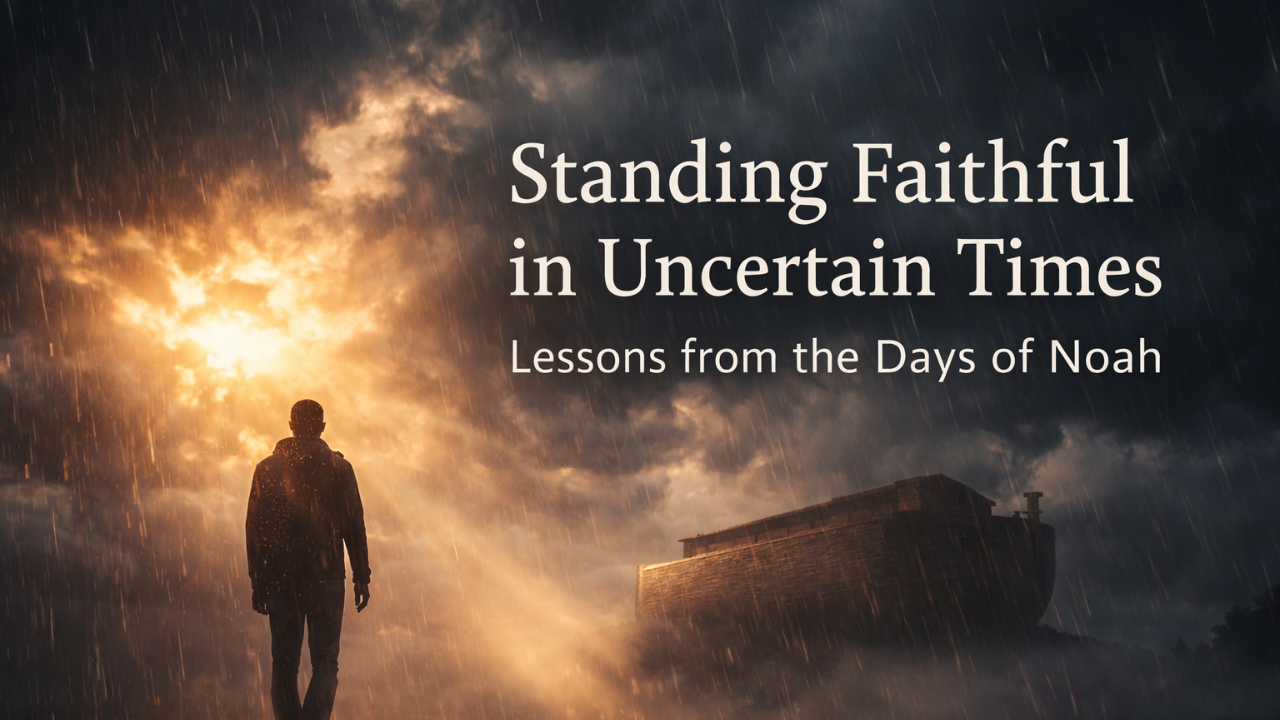
There is a quiet heaviness many people feel today even if they cannot fully explain it. The world seems louder, faster and more unsettled than before. There's a lot of conflict, moral confusion, economic strain and a growing sense that things are not quite right. What was once clearly wrong is now normalized. What was once honored is now questioned and for many believers, there is an unspoken question: How do we remain steady in times like these?
This is not the first time humanity has faced such a moment. Jesus Himself pointed us back to the days of Noah. In Matthew 24:37–39, He said that just as it was in the days of Noah, so it would be before His return. People were eating, drinking, marrying, e.t.c. In other words, life was going on as usual. However, beneath the surface, something was deeply broken. Genesis 6:5 tells us that the thoughts of man’s heart were continually inclined toward evil. Therefore, it wasn’t just occasional wrongdoing but a culture shaped by it.
That description seems very familiar. Today, immorality is often celebrated rather than resisted, truth is treated as flexible and integrity is sometimes seen as weakness. There is pressure (whether subtle or direct) to compromise, to fit in, to stay silent, or to redefine convictions. In many parts of the world, believers are facing open persecution while in others, the pressure is quieter/not as much but just as real. There is the urge to blend in, to avoid standing out and to keep faith private and convenient.
And yet, in the middle of Noah’s generation, one man stood differently. Genesis 6:9 says, “Noah was a just man and perfect in his generations, and Noah walked with God.” That statement is simple but profound. Noah did not change the entire culture around him. Neither did he stop the spread of evil. But he remained faithful and walked with God when it was unpopular, inconvenient and likely misunderstood.
Faithfulness in difficult times has always been costly. Imagine Noah building the ark. It was not a short-term project. Building the ark required years of obedience without visible results. There was no rain yet and no flood in sight. Just a command from God and a calling to obey. People around him likely mocked him, questioned him, or dismissed him entirely but Noah kept building.
How can we be encouraged?
That is what faith often looks like (continuing to obey God when the world around you does not understand why). Today, “building the ark” may not look like constructing something physical but the principle remains the same. For instance, it is choosing integrity at work when others cut corners, guarding your purity when compromise is easier, raising your family in truth when culture pulls in the opposite direction, continuing to pray, to read the Word, and to trust God even when circumstances feel unstable. It is also choosing not to be consumed by fear.
Uncertainty has a way of amplifying anxiety. Global instability, economic pressures, shifting values, etc, can weigh heavily on the mind. However, Scripture repeatedly calls believers to a different posture. Psalm 46:1 reminds us that God is our refuge and strength, a very present help in trouble. Not a distant help. Not a delayed help. A present help. This does not mean we ignore reality. It simply means that we ought to interpret reality through the lens of God’s presence rather than through fear.
Another important lesson from Noah’s story is that God sees faithfulness even when it seems hidden. In a world that often rewards visibility and recognition it can feel discouraging to quietly do what is right but God notices. Hebrews 11:7 tells us that Noah, moved with fear, prepared an ark and became an heir of righteousness. His obedience was not wasted. Neither is yours. If you are striving to live right in a world that feels increasingly wrong, you may feel outnumbered or even isolated at times. But you are not alone. God has always preserved a people who remain faithful to Him, even in the most difficult generations. Your quiet obedience matters more than you think.
How do we live faithfully in times like these?
First, we stay rooted in God. A shallow spiritual life will not withstand a strong cultural current. Prayer and the Word are not optional but essential. They anchor us when everything else feels unstable.
Second, we guard our hearts intentionally. Proverbs 4:23 tells us to keep our hearts with all diligence. In a world of constant input (media, conversations, ideologies, etc), we must be careful what we allow to shape our thinking.
Third, we walk in love without compromising truth. It is possible to be both gracious and firm, kind and convicted. Jesus modeled this perfectly. He was full of grace and truth (John 1:14).
Finally, we live with hope. Noah’s story did not end in destruction. It ended in preservation and a new beginning. God’s judgment was real, but so was His mercy. The same is true today in that no matter how dark things may seem, God is still at work. His purposes are not failing and His promises are still true.
These are not days to withdraw in fear but the days to stand in faith. You may not be called to change the entire world, but you are called to walk with God in your generation, to remain steady when things feel unstable, to build faithfully, even when results are not immediate, and to trust that God sees, God knows and that God is still in control. And just like Noah, that kind of faithfulness will not go unnoticed.