

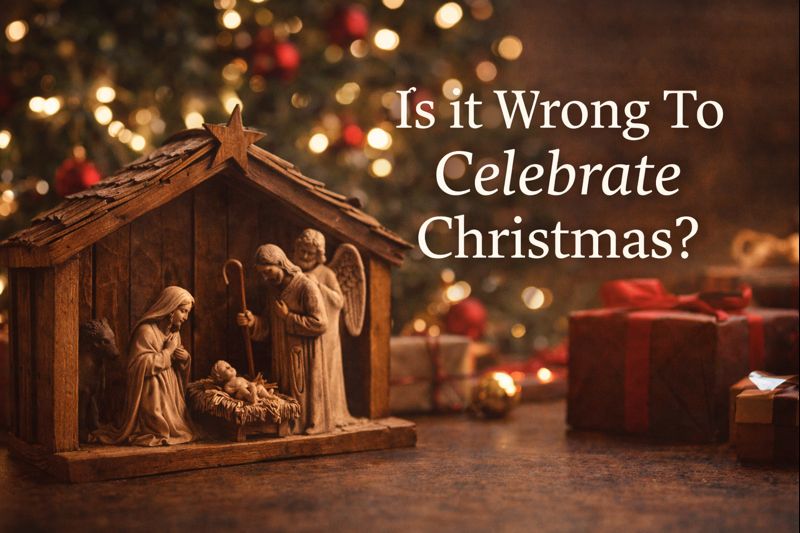
Every year, as lights go up and carols begin to play, the same questions rise among believers: "Should Christians celebrate Christmas?" "Isn’t December 25th a pagan date?" "What about Santa, trees and all the commercial noise?" For some, the season is a time of worship and wonder. For others, it’s a minefield of doubts and debates. In the middle of all this, one truth quietly remains: Christ Himself is the reason we have anything to celebrate at all.
At its heart, Christmas is about the miracle of the incarnation. That the eternal Son of God stepped into our world as a real, humble, human baby. Scripture says, “But when the fulness of the time was come, God sent forth his Son, made of a woman, made under the law, To redeem them that were under the law” (Galatians 4:4–5). Whether or not we know the exact date of His birth, we are commanded to remember and proclaim who He is and what He has done. The angels announced, “For unto you is born this day in the city of David a Saviour, which is Christ the Lord” (Luke 2:11). Christmas, at its best, is simply a focused opportunity to rejoice in that good news.
Was Christ Really Born on December 25th?
One of the biggest questions is the date. The Bible never tells us that Jesus was born on December 25th, and it gives no command to celebrate His birthday on any particular day. That bothers some believers, and understandably so. Historically, December 25th was chosen by the early church long after the New Testament period. Some link it to Roman festivals while others linnk it to early Christian calculations about the time of Christ’s conception. The details are complex and debated, but one thing is clear: Scripture does not bind the conscience of believers to this date. Instead, it gives us a principle: “One man esteemeth one day above another: another esteemeth every day alike. Let every man be fully persuaded in his own mind. He that regardeth the day, regardeth it unto the Lord…” (Romans 14:5–6). This means that sincere Christians may differ. Some will celebrate December 25th as a special time to honor Christ while others will choose not to. Both can please God if of course they do what they do “unto the Lord” and with a clear conscience.
Another concern is the alleged pagan roots of some Christmas customs. This includes the Christmas trees, wreaths, lights and so on. It is true that many cultures had winter festivals long before Christmas. But using an object that once had a pagan association does not automatically make a Christian’s worship pagan. The question is not only, “Where did this custom come from?” but also, “What does it mean in my heart now?” The Bible warns us against idolatry and empty tradition, not against every cultural symbol. We are told, “Beware lest any man spoil you through philosophy and vain deceit, after the tradition of men… and not after Christ” (Colossians 2:8, KJV). If a tree, light, or song draws our hearts to Christ, that is, His life, light and beauty, then we can use it with gratitude and wisdom. If it distracts us, feeds superstition, or stirs old bondage, then we are free to lay it aside. The issue is not the object itself, but the heart that uses it.
Then there is the problem of commercialism and distraction. Even Christians can find themselves more excited about gifts, food, travel and social media photos than about the Son of God made flesh. The world around us has turned Christmas into a season of pressure and performance. A rush of shopping, parties and expectations. We must be honest that this is not just an outside problem. It exposes what we treasure. Jesus warned, “For where your treasure is, there will your heart be also” (Matthew 6:21). If we say Christ is the center of Christmas, but He receives the smallest portion of our time, thought and money, then the issue is not the holiday but it is our hearts. A Christ-centered celebration will feel different. There'll be more worship than worry, more generosity than greed, more time in the Word than time in the mall.
Santa Claus and similar figures raise another question especially for parents. Is it wrong to talk about Santa? Here again, Christians differ. Some choose to avoid the tradition entirely to keep Christ clearly central and to avoid confusing children with fantasy presented as truth. Others may treat Santa as a light-hearted story, while clearly teaching that every good gift comes from God and not from a magical visitor. Scripture doesn’t mention Santa but it does call us to raise children “in the nurture and admonition of the Lord” (Ephesians 6:4) and to speak truth. Whatever choice we make, the priority should be that children understand who Jesus is, what He has done and why His coming is far more glorious than any seasonal story.
Celebrating Christ During Christmas
So how do we celebrate Christ in a way that honors Him and calms the controversies? First, we let Scripture lead the season. Read the accounts of Christ’s coming in Matthew 1–2 and Luke 1–2. Sit with John’s majestic words: “And the Word was made flesh, and dwelt among us” (John 1:14). Let carols and worship songs that are rich in truth fill your home. Use the season to talk about why He came. “Thou shalt call his name JESUS: for he shall save his people from their sins” (Matthew 1:21). The manger only makes sense in the light of the cross and the empty tomb.
Second, we let gratitude and generosity mark our celebrations. Christmas is a wonderful time to echo Paul’s exclamation: “Thanks be unto God for his unspeakable gift” (2 Corinthians 9:15). We can express that gratitude in worship, in loving our families patiently, in forgiving old hurts and in giving to those in need (the lonely neighbor, the struggling church member, the hungry, the forgotten). When we give because God has first given to us, we are not copying the world’s commercialism. Instead, we are reflecting the heart of Christ.
Finally, we walk in charity and humility toward other believers. Some Christians will decorate and feast, others will keep the day very simple and some may choose to avoid Christmas entirely. Romans 14 again reminds us not to despise or judge one another over disputable matters. What we must all agree on is that Jesus Christ, the eternal Son of God, truly came in the flesh, lived a sinless life, died for our sins, rose again and will return in glory. He alone is worthy of worship. Not a date, not a custom, not a tradition. If our celebration lifts Him up, strengthens our love for Him and leads us to obey Him more fully, then it is a season well spent.
In the end, the question is not simply, “Do you celebrate Christmas?” but, “How do you celebrate Christ?” May this season be a fresh opportunity to fix our eyes on Him, to rejoice that God is with us and to let every candle, song, and gathering be a quiet, steady echo of the angel’s proclamation: “Glory to God in the highest, and on earth peace, good will toward men” (Luke 2:14).